
- Price collapse: A one-carat high-quality lab-grown diamond that once cost thousands of dollars wholesale has fallen dramatically. In China, online and factory prices for a one-carat stone commonly range from roughly 1,000–2,000+ RMB (about $140–280 or more depending on quality and certification) in recent reports—often a small fraction of a comparable natural diamond. Broader market data show lab-grown retail prices frequently 70–90%+ lower than equivalent mined stones. A three-carat lab-grown example that retailed near $29,000 around 2020 had dropped to a few thousand dollars by the mid-2020s in some analyses.
A fascinating cosmic reality! On a galactic scale, diamonds are indeed shockingly common compared to wood.
While wood is essentially an Earth-exclusive product requiring complex organic life, biological ecosystems, and centuries of tree growth, diamonds are forged from carbon—one of the most abundant elements in the universe.
Space observations and planetary science show just how common diamonds are out in the cosmos:
-
Diamond Rain: On ice giant planets like Uranus and Neptune, extreme atmospheric pressure strips carbon from methane gas, crystallizing it into solid diamonds that scientists theorize literally rain down toward their cores.
-
Carbon Planets and White Dwarfs: Astronomers have discovered entire star systems and stellar remnants (like white dwarf stars) packed with massive amounts of compressed carbon, effectively creating literal diamond worlds.
-
Stardust: Tiny nanodiamonds—some containing only a couple of thousand carbon atoms—float around freely in interstellar gas clouds and have even been found intact inside meteorites that crashed onto Earth, meaning diamonds existed long before our solar system was even formed.
So, while diamond rings are treated as rare luxury items on Earth, the universe is practically swimming in carbon crystal formations, making biological wood infinitely rarer across space!
BUT ?
Diamonds Are Not Forever: How China Is Manufacturing a New Diamond Age
For more than a century, the diamond industry has sold consumers an extraordinary idea: that a diamond is rare, ancient and almost beyond comparison with ordinary objects.
That story is becoming much harder to sustain.
The famous De Beers slogan “A Diamond Is Forever” once sold scarcity, romance, and permanence. Today that myth is under pressure from factories in central China, where pure carbon is transformed into real diamonds in days rather than geological ages. These lab-grown stones are chemically, physically, and optically identical to mined diamonds. They are virtually indistinguishable to the naked eye (and often to standard gemological tools without specialized equipment). They also cost a fraction of the price.
The epicenter is not a single glamorous laboratory in Shanghai or Shenzhen. It is largely Henan Province, especially the once-obscure agricultural county of Zhecheng (柘城), now widely known as China’s “Diamond Capital.”
A new generation of Chinese manufacturers has learned how to take carbon and, inside sophisticated industrial reactors, reproduce the conditions under which diamond crystals form. The resulting stones are not diamond imitations such as cubic zirconia or moissanite. They are diamonds—chemically, physically and optically very similar to diamonds formed naturally deep inside the Earth.
The remarkable part is the time scale.
A natural diamond may have spent hundreds of millions to billions of years forming underground. A laboratory-grown diamond can be produced in a matter of weeks. GIA says most laboratory-grown diamonds can be grown in less than a month, although production time varies with size and technology.
And China has become one of the world’s most important centers of this manufacturing revolution.
The Chinese factory changing the meaning of a diamond
One company illustrates China’s transformation particularly well: Henan SF Diamond Co., Ltd., based in Henan Province.
In 2024, the Henan provincial government reported the opening of the Merak Functional Diamond Super Factory, associated with SF Diamond. The factory was described as China’s largest CVD diamond factory, with an annual production capacity exceeding 1 million carats of functional diamond products. A separate report on the company’s earlier CVD facility put capacity at about 700,000 carats annually.
The significance is bigger than one factory.
Henan has spent decades developing the machinery and expertise required to manufacture synthetic diamonds. According to the Henan provincial government, China accounts for approximately 95% of global artificial-diamond production, with Henan responsible for roughly 80% of China’s output. These figures encompass the enormous industrial-diamond sector as well as gem-quality material, so they should not be interpreted as 95% of the world’s jewelry-grade diamonds.
That distinction matters.
China’s diamond industry did not begin with engagement rings.
It began with industry.
From cutting tools to jewelry
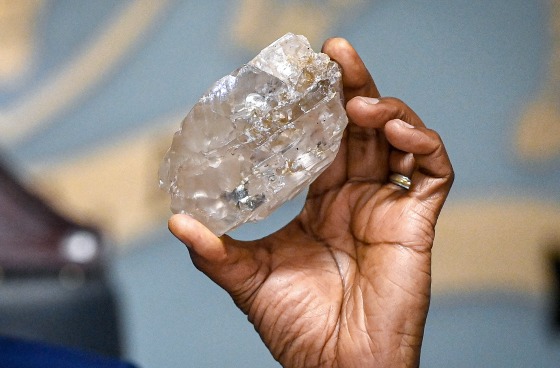
Diamond is one of the hardest naturally occurring materials known, which makes it enormously useful in industry.
For decades, Chinese manufacturers produced synthetic diamond grit and crystals for:
- cutting tools
- grinding
- drilling
- oil and gas equipment
- aerospace applications
- electronics
- semiconductor manufacturing
- precision machinery
Companies such as Henan Huanghe Whirlwind, Zhengzhou Sino-Crystal Diamond and ZhongNan Diamond built enormous expertise in synthetic diamond production.
By 2019, Chinese manufacturers were already moving aggressively from industrial diamonds into jewelry. Chinese industry estimates cited by China.org.cn indicated that companies were producing enormous quantities of synthetic diamond for industrial applications, while manufacturers such as Sino-Crystal were expanding their gem-quality production.
This is one of the most important aspects of the Chinese story.
China did not have to invent an entirely new industry to manufacture jewelry diamonds.
It already possessed the machinery, engineering knowledge, supply chains and industrial infrastructure required to manufacture diamond material.
The next step was simply learning how to make larger, clearer, more attractive crystals suitable for cutting into gemstones.
The two technologies behind the revolution
There are two principal methods used to manufacture laboratory-grown diamonds:
1. HPHT — High Pressure, High Temperature
This technology attempts to reproduce the physical environment in which natural diamonds form.
A tiny diamond seed is placed into a growth capsule together with a carbon source. The system is subjected to extremely high pressures and temperatures. Carbon dissolves and then crystallizes onto the diamond seed.
GIA describes HPHT as a process that mimics the high-pressure, high-temperature conditions associated with natural diamond formation.
China became particularly strong in HPHT technology because the country had already developed a huge synthetic-diamond industry for industrial purposes.
GIA’s 2024 review notes that HPHT remains especially important in China and identifies companies including Zhengzhou Sino-Crystal Diamond, ZhongNan Diamond and Henan Huanghe Whirlwind as major Chinese producers.
2. CVD — Chemical Vapor Deposition
CVD is perhaps the more fascinating technology.
Instead of attempting to reproduce the entire environment deep inside the Earth, CVD grows the diamond one layer at a time.
A thin diamond seed is placed inside a chamber containing a carbon-containing gas, commonly methane, along with hydrogen. Energy creates a plasma that breaks apart the gas molecules.
Carbon atoms then settle onto the diamond seed.
Layer after layer, the crystal grows.
GIA describes CVD as breaking down molecules of a carbon-rich gas and depositing carbon atoms onto diamond seed plates. The result is typically a flat, tabular crystal that can subsequently be cut and polished.
The technology sounds futuristic.
But it is fundamentally a controlled manufacturing process.
And that is the crucial change.
The diamond has gone from being something humans find to something humans manufacture.
A diamond in weeks instead of geological time
This is where the phrase “diamonds are forever” begins to acquire a completely different meaning.
Natural diamonds are extraordinarily old. They formed under geological conditions deep within the Earth, with many dating back hundreds of millions or even billions of years.
Laboratory-grown diamonds compress the growth process dramatically.
GIA reports that growth of most laboratory diamonds takes less than a month, depending on the technology and size.
A Chinese factory therefore does something that nature takes geological ages to accomplish:
it turns carbon into diamond on an industrial production schedule.
That changes the economics completely.
And here is the astonishing part: the eye cannot simply tell you
A laboratory-grown diamond isn’t equivalent to fake diamond glass.
This distinction is extremely important.
Cubic zirconia is not diamond.
Moissanite is not diamond.
A laboratory-grown diamond is diamond.
GIA states that laboratory-grown diamonds have essentially the same chemical composition, crystal structure, optical properties and physical properties as natural diamonds.
To an ordinary observer, a well-cut laboratory-grown diamond can therefore look like a natural diamond.
GIA even notes that traditional gemological observations and older diamond detectors cannot reliably distinguish many laboratory-grown diamonds from natural diamonds. Advanced laboratory equipment is required for definitive identification.
That means something profound has happened to the diamond business:
rarity can no longer be established simply by looking at the stone.
Nature leaves fingerprints—and factories leave fingerprints too
The stones aren’t completely identical in their history.
Natural diamonds grow under geological conditions.
Laboratory diamonds grow under controlled industrial conditions.
Those different environments leave microscopic signatures.
GIA can analyze things such as:
- growth patterns
- fluorescence
- phosphorescence
- strain patterns
- inclusions
- trace elements
- microscopic structures
For example, GIA describes distinctive growth patterns that can help identify natural, HPHT and CVD diamonds.
So the difference is not necessarily visible to the naked eye.
It is often visible to science.
That is why a reputable diamond laboratory report is so important when the origin of a stone matters.
China’s production advantage
China’s advantage isn’t simply cheap labor.
It is the entire industrial ecosystem.
Henan already possessed:
diamond presses + synthetic-diamond expertise + machinery manufacturers + materials scientists + industrial electricity + diamond-processing infrastructure + supply chains
That makes scaling production much easier.
GIA estimated that in 2020 global production of gem-quality laboratory-grown diamonds reached approximately 6–7 million carats, with China producing around 3 million carats, mostly through HPHT. India was estimated at about 1.5 million carats and the United States around 1 million.
In other words, China was already responsible for roughly half of the estimated global gem-quality laboratory-grown diamond output in that estimate.
And Chinese production has continued evolving.
The rise of China’s CVD factories
The CVD story is especially interesting because CVD is well suited to growing larger, high-quality crystals.
The 2024 SF Diamond facility in Henan was reported as having approximately 700,000 carats of annual CVD production capacity, while the company’s later Merak superfactory was described by the provincial government as having capacity exceeding 1 million carats of functional diamond products annually.
Another Chinese company, Henan LiLiang Diamond, founded in 2010, has built a business around diamond single crystals, diamond micropowder and cultivated diamonds. The company says it has more than 100 researchers and more than 100 independent core technology intellectual-property rights.
The industrial story is therefore broader than one manufacturer.
China has developed an ecosystem.
The price revolution
And then came the part that threatened the traditional diamond business:
price.
Once diamonds can be manufactured in large quantities, their price no longer has to reflect the enormous geological scarcity of natural diamonds.
The price difference has become enormous.
De Beers’ 2026 Diamond Report says wholesale prices for synthetic laboratory-grown diamonds have fallen 93% since 2020, with average wholesale pricing around $100 per carat in its cited market data.
Reuters reported in 2025 that wholesale prices for one-to-two-carat laboratory-grown diamonds had fallen by as much as 96% since 2018, with increased production in China and India contributing to the oversupply.
This is the classic economics of manufacturing:
More production → more competition → lower marginal costs → lower prices.
And diamonds are discovering the same economic law that transformed computers, televisions, solar panels and smartphones.
Mining versus manufacturing: the numbers
The environmental comparison is more complicated than either side of the diamond debate sometimes admits.
There is no single universal environmental number for “a laboratory diamond” because factories use different machines, electricity sources and production techniques.
One peer-reviewed study published in Energies compared mining with HPHT and microwave-assisted CVD.
It estimated:
| Production method | Energy per carat | Water per carat |
|---|---|---|
| ALROSA mining | ~96 kWh | ~0.077 m³ |
| De Beers mining | ~150 kWh | Not analyzed |
| HPHT | ~36 kWh | ~0 |
| M-CVD example | ~215 kWh | ~0.002 m³ |
The authors emphasized that CVD energy consumption varies substantially depending on equipment and operating conditions.
This produces an important warning:
It is incorrect to say that every laboratory-grown diamond automatically uses less energy than every mined diamond.
Some laboratory systems can consume enormous amounts of electricity.
The source of that electricity matters enormously.
Carbon emissions tell an even more complicated story
A study published in Humanities and Social Sciences Communications estimated that, under a clean-energy scenario, laboratory-grown diamonds could have substantially lower greenhouse-gas emissions, mineral waste and water use than mined diamonds. Its cited figures were approximately 0.028 kg of GHG emissions, 0.0006 tonnes of mineral waste and 0.07 m³ of water per carat for its clean-energy laboratory scenario, versus approximately 57 kg GHG, 2.63 tonnes of mineral waste and 0.48 m³ of water per carat for mining.
But other analyses produce much higher laboratory-diamond emissions when fossil-fuel electricity is used.
A Natural Diamond Council report citing Sphera estimates, for example, that CVD production could range from about 260 to 612 kg CO₂e per polished carat in certain production scenarios, while a 100% renewable-energy scenario could reduce the estimate to about 17 kg CO₂e.
The lesson is clear:
A laboratory diamond isn’t automatically “green.”
A diamond manufactured with coal-generated electricity is a very different environmental proposition from one manufactured with renewable electricity.
Mining creates something factories don’t: enormous quantities of rock
Mining requires physically removing material from the Earth.
A diamond mine may process enormous quantities of rock to recover relatively small quantities of gem-quality diamonds.
One industry environmental assessment reported an average of approximately 4,350 kilograms of waste rock residues per polished carat from the diamond-mining operations it studied.
Laboratory manufacturing doesn’t require digging a giant open pit to locate a diamond crystal.
The diamond grows inside a reactor.
That eliminates a major category of impacts associated with excavation, waste rock and habitat disturbance.
But again, that doesn’t mean the laboratory process has zero environmental cost.
It substitutes mining infrastructure for industrial infrastructure.
The irony: diamonds became less rare because technology became better
For generations, the natural diamond industry benefited from something manufacturing could not easily reproduce:
scarcity.
A natural diamond had to be discovered.
It had to be mined.
It had to be extracted from rock.
It had to be transported.
It had to be sorted.
It had to be cut.
The supply was therefore constrained by geology and mining economics.
Laboratory production attacks that constraint.
A factory doesn’t need to wait for a volcano.
It doesn’t need to discover a kimberlite pipe.
It doesn’t need to excavate millions of tonnes of earth looking for a few valuable stones.
It needs:
carbon + diamond seeds + specialized machinery + electricity + technicians.
And then it can make more.
China’s real achievement isn’t simply making “fake diamonds”
That description misses the technological revolution.
China has effectively industrialized the production of one of nature’s most remarkable materials.
The same country that became the world’s manufacturing center for countless consumer products has applied that manufacturing philosophy to diamonds.
The progression is striking:
Industrial diamond powder
↓
Synthetic diamond crystals
↓
High-quality industrial diamonds
↓
Gem-quality laboratory diamonds
↓
Large, colorless CVD diamonds
↓
Mass-market jewelry
The transition from industrial diamond to luxury gemstone is therefore not an accident.
It is the culmination of decades of engineering.
But there is one thing a factory cannot manufacture
It cannot manufacture geological history.
A natural diamond may contain a microscopic record of the Earth’s ancient interior.
A laboratory-grown diamond has a different story.
One is a geological artifact.
The other is a technological artifact.
And both are diamonds.
That distinction is likely to become increasingly important.
For someone who values rarity, geological age and natural provenance, the mined diamond has something the laboratory diamond cannot reproduce.
For someone who values appearance, physical properties and price, the laboratory-grown diamond offers an extraordinary alternative.
And for someone primarily interested in environmental impact, the answer depends heavily on how the diamond was produced and where its electricity came from.
The future of the diamond industry
The phrase “diamonds are forever” may survive.
But the economic meaning of the diamond is changing.
A diamond can now be:
- millions or billions of years old;
- or a few weeks old;
- extracted from the Earth;
- or grown inside a reactor;
- exceptionally rare;
- or produced by the hundreds of thousands of carats;
- extremely expensive;
- or increasingly affordable.
And that is why Chinese laboratory-grown diamond manufacturers represent more than a new source of inexpensive jewelry.
They represent a technological challenge to one of the oldest assumptions in the luxury industry:
that beauty must be scarce because nature made it.
China’s diamond factories are demonstrating something very different.
Sometimes, technology doesn’t merely imitate nature.
It learns how nature works—and then manufactures the result.
Sources
The technical and historical claims above are based principally on the Gemological Institute of America, research published in Energies and Humanities and Social Sciences Communications, and reporting from Chinese government and international industry sources. GIA confirms that laboratory-grown diamonds possess essentially the same chemical, physical and optical properties as natural diamonds while having identifiable growth signatures under advanced testing.
China’s position in laboratory-diamond manufacturing, particularly in Henan, is documented by the Henan provincial government and GIA’s industry review.
The energy and water comparison comes from the peer-reviewed Energies study, which emphasizes that laboratory-diamond energy consumption varies significantly by technology and equipment.
Key Statistics: Lab vs. Mine
-
Visual Identity: 100% identical. Because their refractive index, hardness (10 on the Mohs scale), and thermal conductivity are identical to mined diamonds, they pass standard diamond-tester pens and require specialized spectroscopic equipment to differentiate.
-
Price Difference: Lab-grown diamonds typically retail at roughly 20% to 30% the price of an equivalent mined diamond. A stunning 2-carat lab-created ring that costs a fraction of a natural counterpart looks entirely identical to anyone looking at it.
-
Global Output Scale: Worldwide annual production of jewelry-grade rough lab diamonds sits well into the tens of millions of carats, with China accounting for the lion’s share of global volume.
-
Market Adoption: The rise of affordable lab-grown stones has upended traditional jewelry stores. Major retailers (like Walmart and upscale jewelry brands) have rapidly expanded their lab-grown inventories, with lab-grown stones capturing a massive share of engagement ring sales globally.
-
Resale Value Reality: While lab diamonds are cheaper to buy, they generally have lower resale value compared to mined stones, functioning more like fashion and luxury goods rather than long-term investments.
By compressing billions of years of geological pressure into a week-long factory process, Chinese tech innovation has fundamentally democratized what was once one of the most exclusive luxury goods on Earth.
Article credit: abijohn.com
HOSTIFI CHEAP HOSTING