
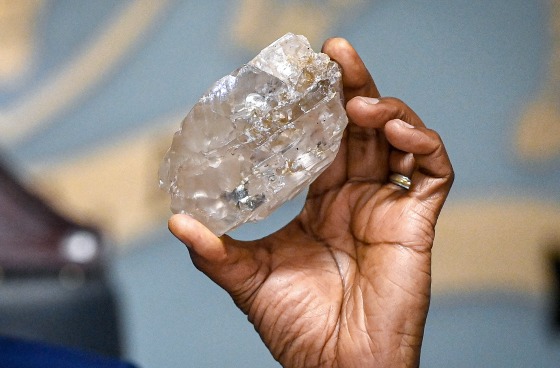
Wood is vastly rarer in the universe than diamonds.
This viral “shocker” fact is correct. While diamonds seem incredibly rare and valuable on Earth, they’re actually quite common across the cosmos. Wood, on the other hand, is an extremely rare biological material that (as far as we know) only exists on one planet: Earth.
Why Diamonds Are Common in the Universe
- Carbon is abundant: Carbon is one of the most common elements in the universe, produced by stars.
- Formation mechanisms: Diamonds form under high pressure in many places without needing life. Examples include:
- Meteorites: Nanodiamonds (tiny ones with just ~2000 carbon atoms) are abundant and even predate our Solar System. Larger ones form from impacts.
- Ice giants: Uranus and Neptune likely have diamond “rains” or layers from compressed methane.
- Exoplanets: Some carbon-rich planets (like hypothetical “diamond planets” or 55 Cancri e) could be partially or largely made of diamond. Early universe carbon planets might have had diamond crusts.
- Stars and interstellar space: Diamonds appear in stardust and other cosmic environments.
Diamonds don’t require biology—just physics and chemistry under the right conditions, which occur frequently on a cosmic scale.
Why Wood Is Extremely Rare
- Wood is biological: It’s primarily cellulose and lignin from trees (vascular plants). This requires:
- Complex photosynthetic life.
- Liquid water.
- A stable atmosphere with oxygen.
- Specific evolutionary history (land plants evolved on Earth ~400+ million years ago).
- No evidence elsewhere: Despite thousands of exoplanets discovered, there’s zero confirmed evidence of extraterrestrial trees, forests, or wood-like materials from life. Wood isn’t a simple mineral—it depends on a full biosphere.
You could theoretically travel the observable universe and never encounter another piece of true wood, while stumbling across diamonds (or diamond-like carbon structures) relatively often in the right environments.
Bottom Line
On Earth, diamonds are rare and expensive due to geology and market dynamics. In the universe? Wood wins the rarity contest by a huge margin—it’s a product of one tiny blue planet’s unique evolutionary story. Next time you’re touching a wooden table, you’re handling one of the cosmos’s rarest substances.
-
- A perfectly habitable zone with liquid water and the right temperature
- Billions of years of complex biological evolution
- Trees and plants utilizing cellular machinery to perform photosynthesis
Depending on how you define “material,” the rarest substance changes dramatically:
-
- Cosmologically Speaking (Biological Matter): Surprisingly, wood is one of the rarest materials in the known universe. While heavy metals (like gold) and crystalline structures (like diamonds) form naturally inside stars and on alien planets, wood requires specific biological processes (photosynthesis) and complex life to exist. Earth is the only place we know of that produces it.
 Medium·Victor Yan +2
 - Physically Speaking (Known Substance): Antimatter is the rarest physical substance in the natural universe. While it was likely abundant during the Big Bang, regular matter dominates today. Artificial production of antimatter in labs requires billions of dollars and produces only a few billionths of a gram, making it the most expensive and scarce material humanity has ever observed
.
- Cosmologically Speaking (Biological Matter): Surprisingly, wood is one of the rarest materials in the known universe. While heavy metals (like gold) and crystalline structures (like diamonds) form naturally inside stars and on alien planets, wood requires specific biological processes (photosynthesis) and complex life to exist. Earth is the only place we know of that produces it.
- Elementally Speaking (Natural Element): Astatine is the rarest naturally occurring element on Earth. It is so highly radioactive and unstable that its longest-lived forms decay within just a few hours. At any given time, there is less than a single gram of it in the entirety of Earth’s crust

Tanzanite is commonly cited by gemologists as being 1,000 times rarer than a diamond.
Here is why this striking blue-violet gemstone holds this reputation:
 Facebook·Shimansky South Africa +1
- Singular Location: It is found in only one place on Earth—a tiny, 4-square-mile stretch of land in the Mererani Hills in Tanzania, in the foothills of Mount Kilimanjaro.
Safi Kilima Tanzanite +3
- Finite Supply: Because it exists in such a highly localized geological formation, experts estimate that the world’s supply of tanzanite will be entirely depleted within the next few decades.
Facebook·Shimansky South Africa +1
- Unique Optical Properties:
Tanzanite is trichroic, meaning the stone can display multiple colors—such as vivid blues, indigos, and violets—depending on the angle from which it is viewed.
Despite being significantly scarcer than diamonds, tanzanite is generally more affordable, with prices typically ranging from

to
per carat depending on qualit